Michael Snow
(B. 1929 Toronto, Canada // D. Toronto, Canada, 2023)- Video Fields, 2015
- In the Way, 2011
- The corner of Braque and Picasso Streets, 2009
- Condensation-A Cove Story, 2008
- Puccini Conservato, 2008
- Reverberlin, 2007
- Triage_April 22 (with Carl Brown and John Kamevaar), 2005
- SSHTOORRTY, 2005
- Line drawing with Synapse, 2003
- Solar Breath (Northern Caryatids), 2002
- Corpus Callosum, 2002
- Prelude, 2000
- Sheeploop, 2000
- The living room, 2000
- La Ferme, 1998
- Place des peaux, 1998
- VUEEUV, 1998
- See you later / Au revoir, 1990
- Seated Figures, 1988
- So Is This, 1982
- Presents, 1981
- Hearing Aid, 1977-1976
- Cover to cover, 1975
- ‘Rameau´s Nephew’ by Diderot (Thanks to Dennis Young) by Wilma Schoen, 1974
- Two sides to every story, 1974
- Observer, 1974
- La Région Centrale, 1971
- Slidelength, 1969-1971
- Side Seat Paintings Slides Sound Film, 1970
- A casting shelved, 1970
- <--> (back and forth), 1969
- Sink, 1969
- Wavelength, 1967
- New York Eye and Ear Control, 1964
- Little walk, 1964
New York Eye and Ear Control, 1964
16mm, B&W, sound. 34 m.
ENG
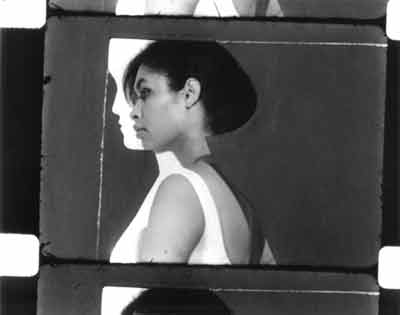
New York Eye and Ear Control prefigures the experiments with perspective and duration that Michael Snow would develop more fully in his later work. Its two-part structure reflects the theme of duality which runs throughout the film both structurally and visually. In the first part, cut-out figures from his Walking Woman Works series of painting and sculptures are placed in various landscapes whose depths contrast with the flat figures. In the second, numerous people pose in a loft with the same figures. The overall calmness of the imagery finds its opposite in the free jazz soundtrack that accompanies it.
Indeed, New York Eye and Ear Control is also an album of group improvisations recorded by an augmented version of Albert Ayler's group compared by the critics with the key free jazz recordings to provide the soundtrack for Michael Snow's film of the same name.
Snow’s work consistently questions the way in which sound and image are associated with each other on film. He says that he “wanted to build simultaneity out of two different classes of things – the image is built around the filming of a static figure placed into live settings. I thought of that as being something classical. Against that, I put freely improvised, very expressive, romantic music. I put together what I thought of as the best band imaginable – the only instruction I gave was that I wanted it to be all ensemble playing and I didn’t want any tunes.”
CAST
New York Eye and Ear Control prefigura los experimentos de contraste, duración y cámara que Michael Snow desarrollaría más tarde. Este trabajo, estructurado en dos partes, refleja la dualidad que atraviesa a ambas, la estructura y las imágenes de la película.
En la primera parte, recortes de su serie The Walking Woman se ubican en distintos paisajes cuya profundidad contrasta con la figura plana. En la segunda parte, varios personajes posan junto a estos recortes en un loft. La calma del conjunto de las imágenes contrasta con el dinamismo del free jazz que constituye la banda sonora.
Los trabajos de Snow siempre prestan atención al modo en que la imagen y el sonido se asocian en una película. En palabras del artista: “trato de construir simultaneidad a partir de cosas de registros diferentes- la imagen se construye en base a la filmación de una figura estática colocada en decorados “vivos”. Pensé en esto como algo clásico y, para contrarrestar utilicé música improvisada libremente, muy expresiva y muy romántica. Junté a al que para mi era el mejor conjunto imaginable y la única instrucción que di fue que no quería melodías y que los quería tocando a todos juntos.”